
Bird, Nest & Egg
The Homes of Forty Extraordinary Species

Bird, Nest & Egg is the result of years spent observing, sketching and studying birds in the field. Through watercolours, drawings and stories from around the world, the book explores the remarkable ways birds build, breed and create a safe place for the next generation.
—

Calliope Hummingbird nest
Original illustration from
Bird, Nest & Egg, Plate 26
Watercolour on paper
25 × 25 cm
2025
Released soon: Join for early acces
—
The book began with a simple question:
How do birds create a safe place to bring the next generation into the world?
The answers are extraordinarily varied. Some weave elaborate structures from grass and spider silk; others nest deep inside tree cavities, on exposed cliff ledges or directly on the ground. Some carefully conceal their eggs, while others rely on defence, camouflage or remarkable partnerships between parents.
Looking at nests became a way of looking at much more than architecture. They reveal how birds have adapted their behaviour, bodies and lives to the environments in which they breed.

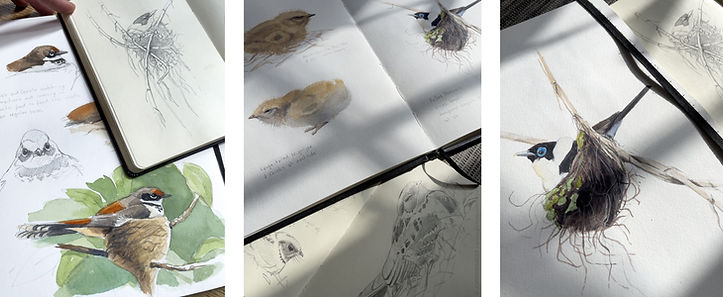
From field observation to illustration
The finished plates in Bird, Nest & Egg are only the final stage of a much longer process. Many did not begin as a single painting. Birds, nests, eggs and behaviour were often drawn or painted separately on paper, or taken directly from field sketchbooks, and later brought together digitally into the final compositions seen in the book.
Behind each plate are field notes, quick sketches, reference photographs, behavioural observations, research, colour studies and sometimes several finished watercolours. For me, illustration is a way of understanding what I am looking at as much as it is a way of showing it.
<< FIELD STORIES
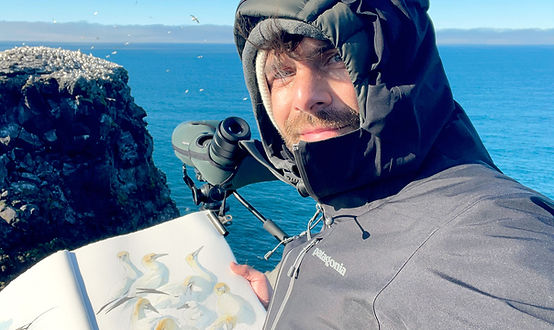
“The finished illustrations are only the final stage.
Behind them are years of travelling, watching, sketching, researching and
trying to understand what the birds are actually doing”
Southern Cassowary - The Rainforest Gardener
—
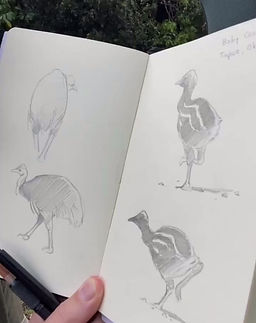
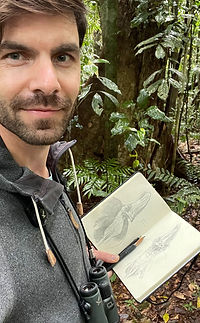
What began as a memorable encounter with a cassowary in Far North Queensland led me to understand how deeply these birds are woven into the rainforest. By swallowing fallen fruit and carrying seeds through the forest, cassowaries help disperse the next generation of trees. Losing the bird can also mean losing part of the process that keeps the forest regenerating.

Burrowing Owls - Fieldwork, patience and conservation
—
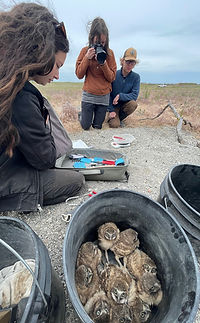
In Oregon, I’ve been helping a team of biologists from the Global Owl Project collect data and band Burrowing Owl chicks. With few badgers in the area to create natural burrows, David H. Johnson and his team have helped save the local population by constructing artificial burrows. Their work has contributed to an extraordinary recovery, from just three breeding pairs 15 years ago to more than 100 pairs today.
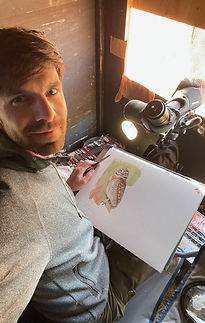
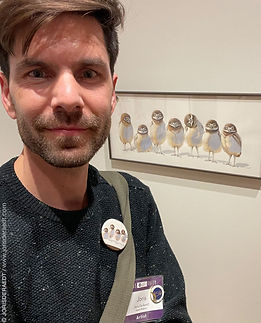
For a month, I observed one pair raising 11 chicks from a blind, sometimes spending up to 10 hours a day watching and sketching this remarkably successful nest site. The final painting I made of the fledglings is now part of the permanent collection of the Leigh Yawkey Woodson Art Museum.

Common Murre - When conservation becomes complicated
—
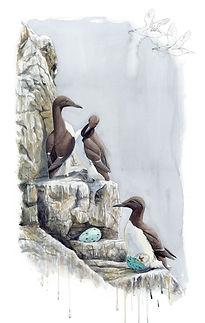
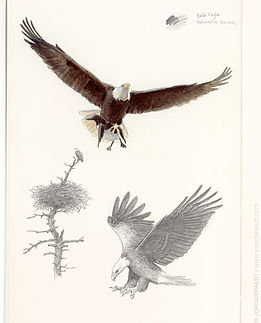
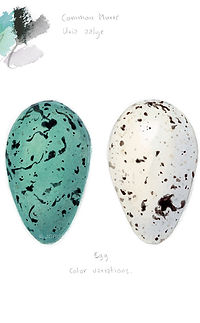
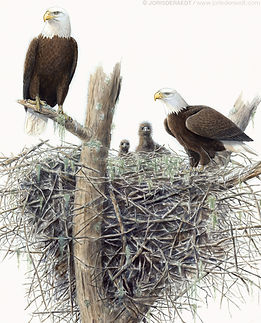
On the Pacific coast of North America I encountered a conservation paradox. The recovery of Bald Eagles is a remarkable success, yet their visits can flush entire Common Murre colonies. Gulls then seize the opportunity to take exposed eggs. It is a reminder that ecosystems are networks: helping one species can change the pressures experienced by another.
Great Hornbill - A nest needs an old tree
—
Great Hornbills take nesting to an extraordinary extreme. The female seals herself inside a natural tree cavity, leaving only a narrow slit through which the male feeds her. In Thailand, studying these nests also made another dependency visible: a hornbill may live in a forest, but without sufficiently large old trees with the right cavities, there may still be nowhere to breed. I saw experienced birds using good nesting trees, but also younger birds attempting to breed for the first time outside the protected area, sometimes in trees that were barely suitable. Large, old hollow trees are scarce, and the best nesting sites are often already occupied. It makes you realise that protecting the bird itself is only part of the story: without the old trees it depends on for breeding, an essential part of its habitat is still missing. You can see how the chick is covered in mud because the nest cavity offers too little protection from the weather.


Extraordinary nesting strategies
The book is organized by nest type, guiding the reader through the remarkable diversity of structures birds create. From simple ground nests to carefully woven or sheltered forms, each type reflects a different solution to the challenges of protection, climate, predators, and raising young. Along the way, the book looks at how materials, location, construction, and behaviour are shaped by the needs of each species and its environment.

Gallery of Eggs
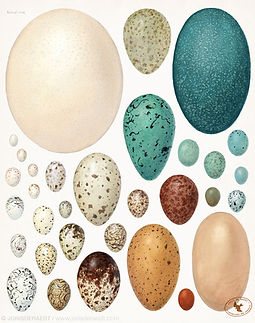
The book also explores the extraordinary diversity of bird eggs, looking at how their size, shape, structure, and composition have evolved to support new life. From tiny hummingbird eggs to the enormous eggs of ostriches, each reflects a different reproductive strategy shaped by a bird’s body size, nesting habits, environment, and way of life. The section also reveals how features such as shell strength, egg shape, and internal membranes help protect the developing chick and meet the demands of incubation.
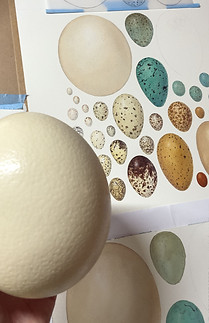
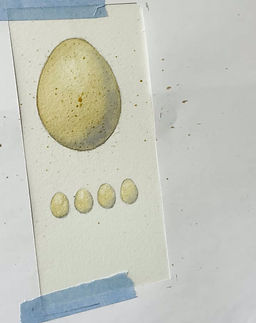
This was the last plate I painted for the book, and probably the most challenging. All 32 eggs are shown at true size, and because the first watercolor wash has to be right, there was very little room for error when bringing them together on a single plate. Color was another difficulty: museum specimens can fade with age, while photographs and online databases vary depending on lighting and camera settings. Finding the most faithful color reference for each egg became an important part of the process.

Originals
More than two hundred individual watercolours and graphite studies were created for forty illustrated plates exploring some of the world's most extraordinary birds and their nesting behaviour.


The Book
A delightful, warmhearted book about home and nesting perfect for bird lovers, naturalists, and anyone charmed by the coziness of a snug nest.
This book is meticulously designed as a large-format visual portfolio of the world’s most distinctive birds, whose nesting behaviour and natural beauty are celebrated in beautifully detailed graphite and watercolour illustrations — all based on actual field studies. The exquisitely detailed bird, nest, and egg portraits are framed by details that include building techniques, materials, egg characteristics (shapes, colours, and number in a clutch), hatchlings and chicks, and parenting behaviours.
Nowhere is avian ingenuity more beautifully expressed than in the construction of nests. The book is organized into chapters based on species’ nesting techniques: South America’s crested oropendola, whose intricate, pendulous, sphere-like nests hang in trees like holiday ornaments; Arizona’s ferruginous pygmy owl, whose nests are hidden in vicious yet protective thorns and bristles of giant saguaro cacti; and peregrine falcons, who scrape out a shallow depression called an eyrie in the sides of cliffs or—in urban settings — ledges on skyscrapers.
This beautiful book celebrates the very idea of making a warm, cozy home. It is also a timely reminder of the diversity, beauty, and ingenuity of the avian world.
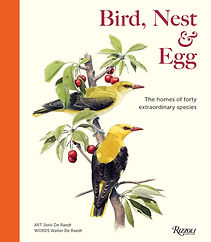
English edition : 112 pages | 345 x 285mm (11 ¼ x 13 ½ in)
English
Publishers : Rizzoli
EAN 978-0-8478-7590-0
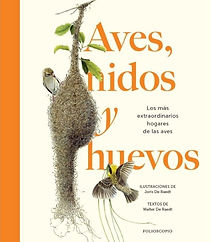
Spanish
Publishers : Folioscopio
EAN 978-0-8478-7590-0
German and Chinese editions are in the making.

Dutch
Publishers : Lannoo
EAN: 9789059965553
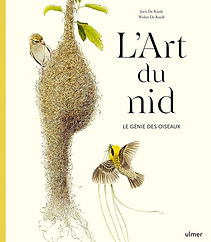
French
Publishers : Edition Ulmer
ISBN: 9782379224652
Interested in a signed copy of the Dutch edition?
Join us for the book presentation on 25 October, or visit the exhibition from 6–15 November, featuring a large selection of the original artworks from the book.
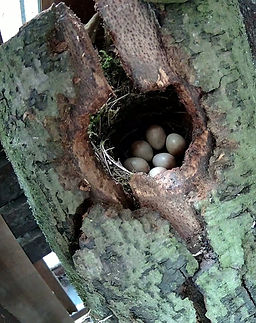
The stories continue - Robin nest at home
—
One spring, a pair of robins chose to nest in an old woodpecker cavity that I had kept beside the front door as a drawing reference. A small camera allowed me to follow the nest from eggs to hatchlings.
When the brood later failed, I began looking for a possible cause. At first, I suspected predation, but when I reviewed the recordings, I saw that one of the parents had removed the dead hatchlings from the nest. While examining the nest material more closely, I noticed long cat hairs woven into it. This led me to research an unexpected connection between veterinary flea treatments, pet fur, and wild bird nests. One possible explanation is that pesticide residues contributed to the chicks’ deaths, after which the parents removed them as part of their natural nest-sanitation behaviour.
